
Shinkansen Family & Group Booking: How to Sit Together
For a family or group, choose one departure and check the issued car and seat numbers for every passenger. Requesting seats together does not guarantee adjacent seats. Check the actual layout, passenger details and luggage arrangements before finalizing your plans.
Passenger details and separate seats for children
JR Central distinguishes adults aged 12 and over, children aged 6–11, young children aged 1–5, and infants under one. School-entry exceptions can affect the age categories, so check the official rule when a child is close to a boundary. Enter passenger details according to the booking instructions.
| Check | What to confirm |
|---|---|
| Passenger details | Use the age and passenger category required by the booking product. Check the operator guidance when a child is near an age or school-entry boundary. |
| A young child using a separate reserved seat | Check which child ticket is needed and include that seat in the reservation. |
| Everyone sitting together | Check the actual car, row and seat letters. A group request alone does not confirm adjacent places. |
| Luggage and a stroller | Check the available storage and any required baggage reservation before choosing seats. |
If a young child needs their own reserved seat, include that requirement when planning the party. Do not assume that entering an accompanying child in the passenger list automatically assigns a separate seat. Check the product instructions and the JR Central passenger-category rules.
Choose a seat combination that fits the group
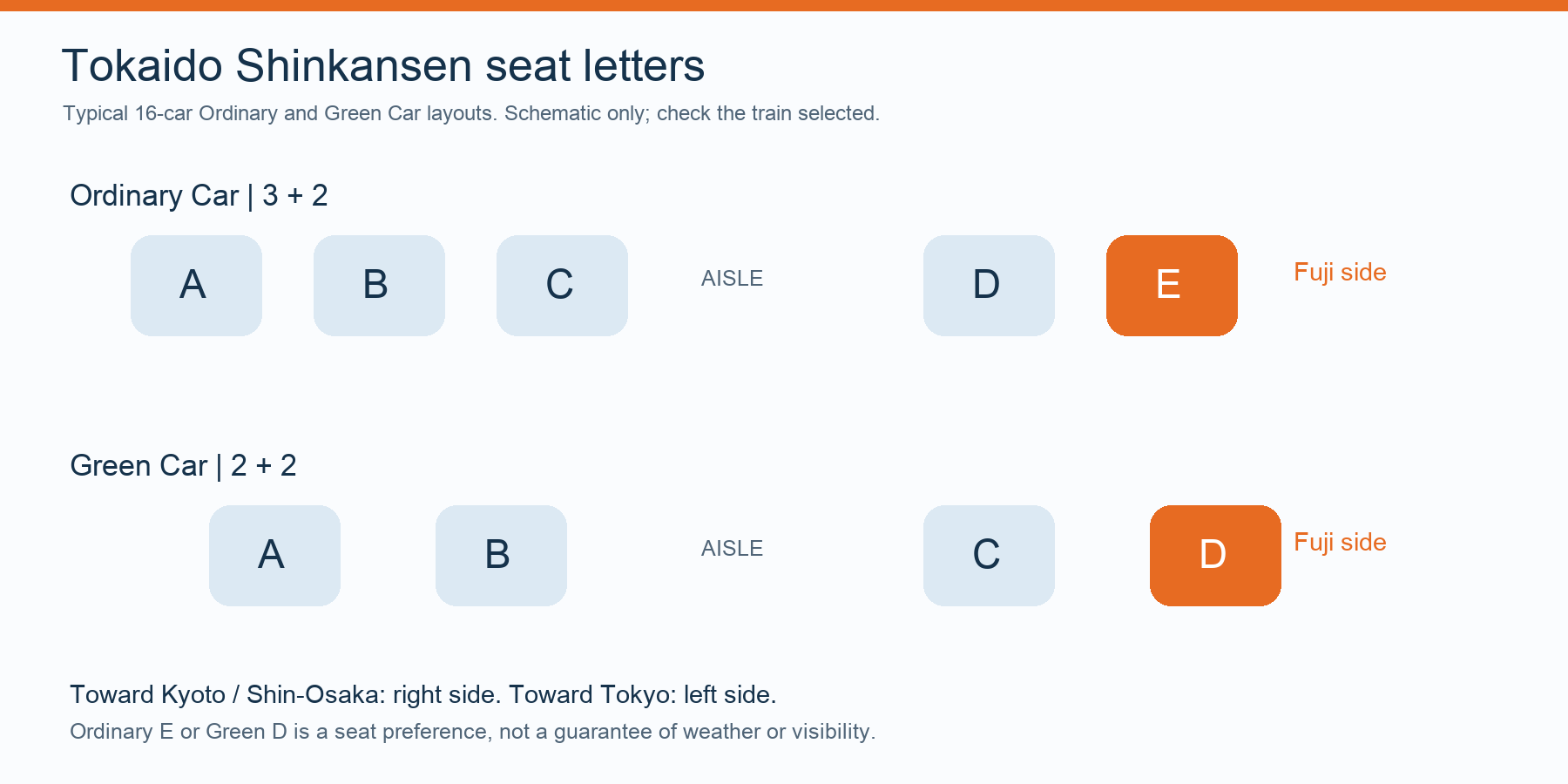
Typical Tokaido Ordinary Cars use A–B–C on one side of the aisle and D–E on the other. A family of three may prefer A–B–C in the same row. Four travelers can compare two adjacent D–E pairs in consecutive rows or another arrangement offered by the seat map. Other Shinkansen train sets can have different layouts.
Four seats A–B–C–D in one row span the aisle; they do not make a four-person facing booth. Some seats can rotate, but rotate only an appropriate bank occupied by your party, consider passengers beside or behind it, and follow staff instructions. Do not obstruct other passengers or assume a rotation feature on every train.
For a larger party, prioritize a practical arrangement such as neighboring rows in the same car. If the booking channel accepts a seating preference, check the actual car and seat numbers after issuance. Let every adult know the meeting point and train details in case the party separates at the station.
Ordinary Car or Green Car?
Choose between Ordinary Car and Green Car according to the actual layout, available seats and your family's needs. Compare aisle access and how your party can be arranged. Children can travel in either cabin under the applicable ticket rules; no cabin guarantees silence or that all members of a group will be seated together.
The seat classes guide shows why cabin class and reservation type are separate decisions. A reserved seat confirms one passenger's place, not the whole group's proximity.
Book around availability, luggage and busy dates
Reservation windows vary by booking product. Some services accept advance requests before the specific train and seat numbers are confirmed. Check the confirmation stage stated in your booking and review the issued assignments when they become available. An early request is not proof that a preferred row has been secured.
Major holidays and certain busy periods can change Nozomi operations to all-reserved seating. Check the current dates rather than assuming that cars 1–3 always provide non-reserved seats. If a suitable group arrangement is unavailable, compare another departure before splitting the booking.
On the Tokaido, Sanyo and Kyushu Shinkansen, baggage over 160 cm and up to 250 cm in combined dimensions needs the applicable seat with an oversized baggage space. Baggage over 250 cm cannot be brought on board, and other limits still apply. A normal reservation or a note in a comments box does not confirm the required storage. Check the current operator rules for strollers and other special items.
Make departure day manageable
- Check passenger ages, stations, date, train, car, seats and baggage arrangements before travel.
- Read collection instructions for every ticket and allow time for pickup and elevators.
- Buy food before boarding if you will need a meal; onboard availability varies.
- Keep aisles clear and ask staff about available assistance or facilities.
- Confirm your car marker and let arriving passengers leave before boarding.
Our boarding guide and ticket pickup guide explain the next steps without assuming every product uses the same QR code.
For travel between Tokyo and Kyoto, use the Tokyo to Kyoto route guide to check departure-station choices before selecting a train for the whole party.
Official sources and travel-date checks
Reviewed on 16 October 2026. Available seats, collection arrangements and booking conditions can change. Check the operator guidance and the instructions issued with your ticket before travel.